Atomic Insights #8: LinkedIn Content Posting in 2026 - What 13 Months of Posts and DMs Actually Built (and Why Not Posting Is The Quiet Killer)
Over the last 13 months I sent 6,335 cold messages on LinkedIn. They got 667 direct replies.
In the same period, I gained 2,269 new followers. Most of them never liked a post. Never replied. Never DMed.
Cold outreach built my conversations. Posting built my audience.
They cost about the same to run. One of them I almost stopped doing.
Here's what happened when I did.
If you're new here, this is Atomic Insights, practitioner notes from running a Singapore-based AI SDR platform. The first seven issues walked through the acts of outbound. Connections, comments, profile, SSI, Sales Navigator filters, hyper-personalised messaging, follow-ups.
Every issue was about what you do to a prospect.
This one is different. It is about what they see when you do it.
1. THE LURKERS ARE YOUR PIPELINE
The biggest leak in B2B outbound isn't bad first messages.
It's that you're only talking to one in three of the people watching you.
Across 13 months I sent 6,335 cold messages on LinkedIn. 4,309 invites with notes. 2,026 first messages on already-connected prospects.
They produced 667 direct replies.
10.53% response rate.
In the same window, my follower count went from 4,340 to 6,609.
2,269 new followers.
Some of them accepted my connection requests. Most didn't come from outreach at all.
Most were lurkers.
Two of those silent watchers have since closed as paying customers. Recurring revenue til today. Both told me they had been reading the posts for months before they reached out.
Neither of them ever liked a single post.
The default assumption in B2B sales is the loud ones are the pipeline. Likes, comments, reposts.
They are not.
The silent followers are the pipeline. They watch. They evaluate. They wait. When the timing fits, they DM.
360Brew, LinkedIn's 150-billion-parameter AI model, knows this. It quietly tracks how many people read your posts without engaging. Dwell time and saves carry far more weight than likes. A save is worth 5 to 10 times a like in the algorithm's eyes.
The lurkers are the model's primary signal that you are trusted.
If you are not posting, that signal is empty.
Atomic Action Steps:
- Count your followers today. Add 1,000 to that number. That is the audience you can build over the next 12 months if you post 2 to 3 times per week.
- Tag the last 50 inbound DMs you received. Count how many ever liked or commented on one of your posts before reaching out. Most will not have.
- Stop measuring posts by likes. Measure them by new followers and profile views over the next 30 days.
2. THE OPEN TAB
Here is what happens after you send a cold DM.
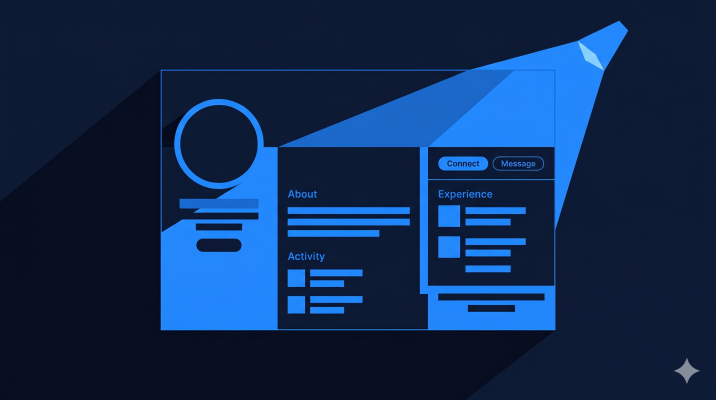
The prospect reads the first line. If it lands, they click your name. A second tab opens. They scan your profile in under 6 seconds.
One of the first few things they see is your latest post.
If your most recent post is two months old, the tab closes. If it is a generic "thrilled to be at [conference]" post, the tab closes. If it is something specific, sharp, and relevant to the message you just sent, they read it.
Then they reply.
Here is the uncomfortable part. I cannot prove this with weekly correlation data. My cold reply rate did not move much when I dropped my posting cadence from 4.7 posts a week to 1.2.
Here is what did move.
When I stopped posting for a month last year, my 90-day profile views collapsed from 859 to 305.
A 64.5% drop. Same profile. Same outbound campaigns. Two-thirds fewer people clicking through to evaluate me.
Profile views are the leading indicator. They are the lurkers in motion.
A cold DM landing on a stale profile does not fail at the message level. It fails at the second tab. The prospect never bothers to reply. You do not see it in your reply rate. You see it nowhere on your dashboard until your conversation count quietly falls off a cliff three months later.
That is why "not posting" is the quiet killer. The metric you track day-to-day does not budge. The metric that matters bleeds out underneath it.
360Brew uses your posting activity to decide how prominently to surface your messages and connection requests. A profile that has not posted in three weeks gets ranked lower. Your DMs land further down the inbox. Your invites lose to the active competitors.
Posting is not a separate workstream from outbound. It is the upstream water supply.
Atomic Action Steps:
- Open your own LinkedIn profile in an incognito tab. Read the first 6 seconds the way a stranger would. If you would not reply to a DM from this person, fix the profile before you fix the message.
- Check your 90-day profile views in LinkedIn analytics. If they have dropped more than 20% in the last quarter, your posting cadence is the most likely cause.
- Schedule your next post within 24 hours of reading this. The hardest one is the first one back.
3. WHAT TO POST: THE FORMAT MATRIX
The format question matters more than most SDRs think.
Different formats train 360Brew on different things. They also give the lurker a different experience inside the same 6-second window.
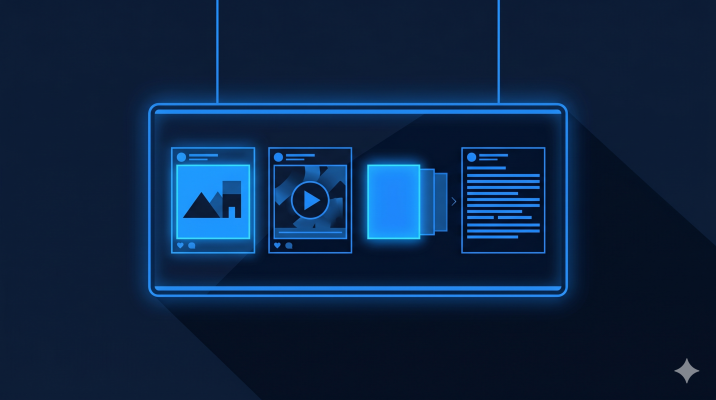
Four formats. Four jobs.
- Text-only posts
The highest raw reach format. 360Brew favours text for opinion-led content because dwell time is easy to measure and comments are easy to weight.
Best for: contrarian takes. A position you would defend over coffee. The "until now everyone said X, this week I saw Y" structure.
What works: under 200 words. Hook in the first line. Short paragraphs. Aggressive white space.
- Image posts
A picture moves slower than text. Reach is lower. Trust is higher.
Best for: receipts. Screenshots of a customer reply. A photo from a meeting that proves the story. A whiteboard sketch.
Avoid stock photos. The platform has been trained to deprioritise generic visuals since the 360Brew update.
- Carousels (PDF documents)
Carousels generate the highest dwell time of any format. They also generate the highest save rate.
Saves are weighted 5 to 10 times a like in 360Brew. A 10-save carousel often outranks a 100-like text post in the model's eyes.
Best for: frameworks. Step-by-step playbooks. Data breakdowns the reader will want to come back to.
What works: 8 to 10 slides. One idea per slide. The cover slide does the work of a hook. The closing slide gives a soft CTA, usually "DM me [WORD] for the full breakdown."
- Video posts
Lowest organic reach historically. But LinkedIn is pushing video hard in 2026, so the model is re-weighting in its favour.
Best for: founder voice content. Talking head explainers. Behind-the-scenes from a customer call (with permission).
What works: under 90 seconds. Subtitles. The first 3 seconds must hook without sound. Most LinkedIn users watch on mute.
The matrix to use:
- Contrarian take? Text post.
- Real receipt or proof? Image.
- Framework or playbook? Carousel.
- Founder voice or behind-the-scenes? Video.
Do not pick the format you are best at. Pick the format the message demands.
Atomic Action Steps:
- Audit your last 10 posts. How many were text, image, carousel, video? If 9 are text and 1 is anything else, you are under-using the formats 360Brew weights highest.
- Turn your best-performing text post from the last 30 days into a carousel. Same message, different format, higher save rate.
- Record one short video this week. Under 90 seconds, sub-titled, talking head. Lower reach. Deeper engagement.
4. AI + HUMAN EXPERT-IN-THE-LOOP IS HOW SDRS POST
 Here at Atomic BI, we prefer the term "human expert in the loop"
I witnessed a debate on my LinkedIn feed recently.
Someone called out Russell Brunson for posting AI-generated content. Her line: "20+ years of experience to share, but he chose AI slop over it to sound like everyone else."
Many people pushed back in the comments. "AI is just another leverage tool."
Both are right. The synthesis is the lesson.
AI is leverage. Without a human expert, leverage is just faster slop.
This is the same model Atomic BI applies to cold outreach. AI generates the draft. A human expert reviews, edits, and approves. We reject roughly 69% of AI-generated drafts before they ship (Issue #6 covered the data).
The same discipline applies to posting.
A pure-AI post is what 360Brew is being explicitly trained to suppress. The model is now flagging templated, formulaic language. Comments under 15 words. Phrases that show up in 10,000 other posts. All deprioritised.
A pure-human post is what most SDRs cannot sustain. Writing a 200-word LinkedIn post from scratch takes 30 minutes when you are trying to do it well.
The path that works for a working SDR:
- Capture the raw thinking out loud. Use voice-to-text into a notes app. Three minutes.
- Hand it to an AI agent (or instructions in your platform). Ask it to structure, not write. Two minutes.
- Edit the draft as a human expert. Add a specific number. Cut the generic lines. Make sure one sentence sounds like you would say it over coffee. Five minutes.
- Post.
Total time: 10 minutes. AI did the heavy lifting. The human expert stopped it from being slop.
The 69% rejection rate is not a bug. It is the value.
If you ship every draft AI generates, your posts read like the 10,000 other AI-generated posts in your prospect's feed that week. Your DM lands on a profile 360Brew has already flagged as low-signal.
Atomic Action Steps:
- Use voice-to-text to capture your next 3 post ideas as raw thinking. Do not try to write them in one go.
- Run each through an AI agent for structure only, not for content. Keep the specifics human.
- Build a personal version of the human expert review gate. Cut at least one generic line per post. Add at least one specific number or named moment.
5. WHAT GOOD LOOKS LIKE: BENCHMARK BY YOUR TIER
Most SDRs benchmark themselves against the wrong posts.
They look at a viral post with 200,000 impressions and conclude their own 800-impression post is broken. It is not. They are comparing themselves to survivorship bias.
The honest benchmark is your follower tier.
Luke Costley-White published the cleanest version of this a couple months ago:
- Under 1,000 followers: 2-4% engagement rate is good
- 1,000 to 5,000 followers: 1.5-3% is good
- 5,000 to 10,000 followers: 1-2.5% is good
- 10,000+ followers: 0.8-2% is good
The pattern is counterintuitive. The bigger your audience gets, the lower your engagement rate should be, because the audience widens beyond your tight network into the lurker pool.
A 1% engagement rate at 10,000 followers means 100 people engaged. That is better than a 4% engagement rate at 500 followers, which is 20.
Across the last 13 months I posted 194 times. My average engagement rate was 3.18%. Median 3.07%.
My follower count grew from 4,340 to 6,609 in that window, placing me in the 5,000-10,000 tier where 1-2.5% is "good." I sat above that range for most of the year.
The metric most B2B teams should track instead of engagement rate is profile views per post.
Engagement rate is what the people who already follow you do. Profile views are what the strangers in the feed do.
For cold outbound, the strangers are the pipeline.
When my posting dropped from 4.7 a week to 1.2 a week, my 90-day profile views fell 64.5%. The engagement rate barely moved. The lurker traffic to my profile fell off a cliff.
Atomic Action Steps:
- Check your engagement rate against your follower tier this week. If it is in the good range, stop chasing the next viral hit and start protecting consistency.
- Track profile views per post as your primary metric. It is the lurker indicator. It is the leading signal for inbound.
- Do not benchmark against viral posts. Benchmark against your tier and your own last 90 days.
6. POSTING CADENCE WHEN YOU ARE ALSO DOING OUTBOUND
The sweet spot for B2B sales is 2 to 5 posts per week.
Less than 2, and 360Brew classifies you as inactive. Your DMs lose ranking. Your invites move down the queue.
More than 5, and the content gets thin. Your time gets eaten. The work that paid for the SDR role in the first place starts to slip.
I ran 4.7 posts a week for 34 weeks (April to November 2025). New followers averaged 56 a week. 90-day profile views peaked at 859.
I dropped to 1.2 posts a week for 18 weeks (December 2025 to April 2026). New followers fell to 32 a week. Profile views collapsed to 305.
I came back at 3 posts a week paired with the Atomic Insights newsletter (late April to May 2026). New followers jumped to 267 a week. Engagement rate climbed above 5%.
The band is 2 to 5 posts a week. Anchor the cadence to a newsletter or a series and you compound faster than raw volume.
The practitioner system that works for an SDR who also has outbound to run:
- One Tuesday morning writing block. 90 minutes.
- Capture 3 to 5 raw post ideas via voice-to-text the week before. You already have them. They are in your DMs, your calls, your customer wins.
- Run each through AI for structure. Edit as a human expert. Schedule for Tue, Wed, Thu (the same cadence we use for follow-ups in Issue #7).
- Reply to every comment on your post within 24 hours. Cognism's 2026 data shows replying after posting boosts performance for 80%+ of profiles.
Weekends are dead on LinkedIn. So is Friday afternoon for B2B.
The 6-month rule: posting compounds slowly. The two customers who closed from posts both told me they had been reading for months before they DMed. Trust takes that long to build.
Most teams quit at month 2. The teams that hold the line for 12 months own the lurker pool.
Atomic Action Steps:
- Block 90 minutes on Tuesday morning every week for content. Treat it like a customer meeting. Do not move it.
- Set the floor at 2 posts a week and the ceiling at 5. Below the floor is a missed opportunity. Above the ceiling is burnout.
- Pair your posting cadence to a recurring asset (newsletter, series, weekly customer win). That is the compounding multiplier.
FREQUENTLY ASKED QUESTIONS
Does posting on LinkedIn actually improve cold DM response rates?
Not directly. Across 13 months of my own data (6,335 cold messages, 667 replies), reply rate did not track weekly posting cadence cleanly. The actual lift from posting shows up in follower growth, profile views, and inbound DMs from lurkers, not in the cold reply rate itself.
How many times should a B2B salesperson post on LinkedIn per week in 2026?
2 to 5 posts per week. Below 2, the 360Brew algorithm classifies you as inactive and your DMs lose ranking. Above 5, content quality drops and your outbound work suffers. The sweet spot for most working SDRs is 3 sharp posts a week, anchored to a recurring series or newsletter.
What should B2B salespeople post about if the goal is cold outreach?
The same conversations you have over coffee with customers. Specific stories. Real numbers. Contrarian takes from inside your daily practice. Not generic tips. Not motivational quotes. Lurkers in 2026 can spot an AI-generated "10 tips for sales success" carousel from a mile away, and 360Brew is now actively suppressing them.
Will AI-generated LinkedIn posts hurt my outbound?
Yes, if you ship them unedited. 360Brew is being trained to deprioritise templated, formulaic content. A pure-AI post lands in front of your prospect looking the same as 10,000 other AI posts. Use AI to structure, not to write. The human expert edit is what stops the content being slop.
How long until LinkedIn posting starts showing up as pipeline?
3 to 6 months for noticeable inbound traffic. 12 months for real revenue. The two customers I closed from posts both told me they had been reading for months before reaching out. Lurker pipelines compound slowly. Most teams quit at month 2 and never see the curve.
COMPLETE THIS WEEK:
- Tag the last 50 inbound DMs you received. Count how many ever liked a post before reaching out. Most will not have.
- Open your LinkedIn profile in an incognito tab. If you would not reply to a DM from this person, the profile is the first fix.
- Block 90 minutes Tuesday morning for content. Treat it like a customer meeting.
- Use voice-to-text to capture 3 post ideas this week. Edit as a human expert. Ship Tue, Wed, Thu.
- Stop benchmarking against viral posts. Benchmark against your tier and your own last 90 days.
Posting does not make a bad first message good. It makes your audience bigger. And the leverage shows up as inbound, recovery weeks, and a profile that 360Brew quietly trusts.

Want to see how AI-powered LinkedIn outreach actually works - with 13-27% response rates and messaging that sounds like you, not a bot? Book a call and we'll show you.
More Atomic Insights coming soon ⚛️