Atomic Insights #4: LinkedIn SSI in 2026 - The Score That Predicts Your Pipeline
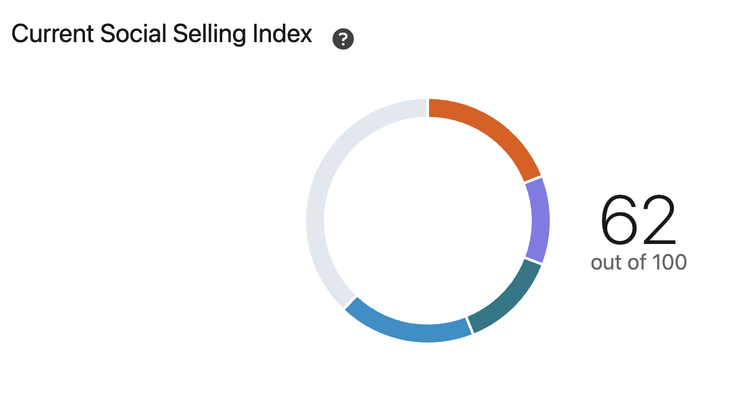
I checked my LinkedIn SSI score last Tuesday. 62.
Not great. Not terrible. Then I checked Toby's - our CTO. 54.
Now - Toby builds the product. He doesn't need a high SSI. But I'm the one doing outbound every day. And 62 means I'm leaving pipeline on the table.
How many sales professionals - the people whose livelihoods literally depend on LinkedIn outreach - have never once checked their SSI score?
Turns out, most of them.
LinkedIn gives you a real-time dashboard that scores your sales readiness across four specific pillars. Updated daily. And almost nobody in B2B sales is using it as the diagnostic tool it's meant to be.
That changes today.
If you're new to Atomic Insights, welcome. This is a fortnightly LinkedIn newsletter where I break down one LinkedIn strategy topic with specific, actionable advice - no fluff, no theory, just what's actually working in 2026.
In previous issues, we've covered why spray-and-pray connection requests are dead (Issue #1), how comments now carry 15x more algorithmic weight than likes (Issue #2), and how to turn your profile into a landing page that converts (Issue #3).
Today's topic ties all three together - because your SSI score is literally measuring whether you're doing those things well.
1. YOUR SSI ISN'T A VANITY METRIC - IT'S YOUR OUTBOUND DASHBOARD
Let's start with what SSI actually is.
LinkedIn's Social Selling Index is a score from 0 to 100 that measures how effectively you're using LinkedIn for sales. It updates daily based on your last 90 days of activity. You can check it at linkedin.com/sales/ssi - though you'll need at least a LinkedIn Premium or Sales Navigator account to access the full dashboard.
Don't have a Premium or Sales Navigator account? We have a limited number of referral invites that give you 2 months of Sales Navigator free. DM me or book a call and we'll get you set up - no strings attached.
Most people treat SSI like a credit score: check it once, feel vaguely good or bad, then forget about it.
That's a mistake.
LinkedIn's own data shows that professionals with high SSI scores create 45% more opportunities and are 51% more likely to hit quota than peers with lower scores.
Here's the thing nobody says out loud: SSI doesn't cause better results. The behaviours SSI measures cause better results. Your score is just the dashboard that tells you which behaviours you're nailing and which ones are costing you pipeline.
Think of it this way: your SSI is the check engine light for your outbound. You can ignore it. But when your response rates start dropping and your connection requests stop getting accepted, don't say the dashboard didn't warn you.
The average LinkedIn user scores 40-50. B2B sales professionals average 55-70. High-performing sales teams maintain 65+. And the top 1%? They're scoring 75 and above.
Where do you sit?
Atomic Action Steps
- Check your SSI score at linkedin.com/sales/ssi. Screenshot it. Write down your total and each pillar score. (No Sales Navigator? DM me - we have referral invites for 2 months free.)
- Compare your score to your team's average. If you're a sales leader, have every rep check theirs this week and share in a Slack channel.
- Identify your lowest-scoring pillar - that's where you're leaving the most pipeline on the table.
2. THE FOUR PILLARS - AND WHAT EACH ONE ACTUALLY MEASURES
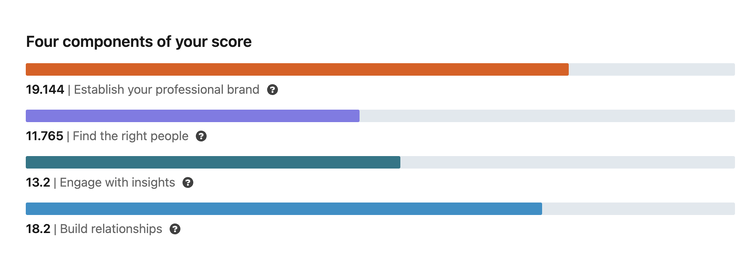 The Four Pillars of SSI
SSI isn't one number. It's four numbers stacked on top of each other. Each pillar is worth up to 25 points, and each one maps directly to a behaviour that drives outbound results.
Here's what they measure - and what each one is really telling you:
Pillar 1: Establish Your Professional Brand (up to 25 points)
This is your profile. Headline, About section, Featured content, experience entries - the stuff we covered in Atomic Insights #3. LinkedIn scores how complete, how professional, and how consistently you show up. Profiles with "All-Star" status (100% complete) are 40x more likely to receive opportunities.
If this pillar is low, prospects are landing on your profile and bouncing. Your outreach is doing the hard work of getting attention - and your profile is wasting it.
Pillar 2: Find the Right People (up to 25 points)
This measures your search and prospecting behaviour. Are you using advanced filters? Viewing profiles in your ICP? LinkedIn tracks how intentionally you're identifying decision-makers versus just scrolling your feed.
Low score here? You're mass-connecting without a prospecting playbook. 360Brew notices - unfocused search patterns signal low-quality intent.
Pillar 3: Engage with Insights (up to 25 points)
Your content and commenting activity. Posts, comments, shares - and critically, quality. As we covered in Atomic Insights #2, 360Brew's Depth Score means 15-word substantive comments count far more than "Great post!" reactions.
Low score = you're invisible to the people you're trying to sell to.
Pillar 4: Build Relationships (up to 25 points)
This measures your connection growth, the seniority of your connections, and the strength of your network. Are you connecting with decision-makers? Are those connections leading to conversations? Are people accepting your requests?
This is the pillar that most directly correlates with outbound success. Atomic Insights #1 covered the connection strategies that feed this score - if you missed it, go back and read it.
Here's the pattern: each pillar maps to a previous Atomic Insights topic. Connections (Issue #1), Comments (Issue #2), Profile (Issue #3) - and now the dashboard that ties them all together.
Was that planned from the start? I'll let you decide. (Toby thinks it was luck. Moonshi says it was strategy. I'm keeping my mouth shut.)
Atomic Action Steps
- Write down your score for each pillar. Note which is highest and which is lowest.
- Map each pillar to the corresponding Atomic Insights issue for a specific improvement plan: Pillar 1 → Issue #3, Pillar 3 → Issue #2, Pillar 4 → Issue #1.
- Focus your next two weeks on your weakest pillar only. A 10-point improvement in your weakest pillar typically delivers a 15-20% increase in qualified conversations.
3. HOW 360BREW READS YOUR SSI BEHAVIOURS
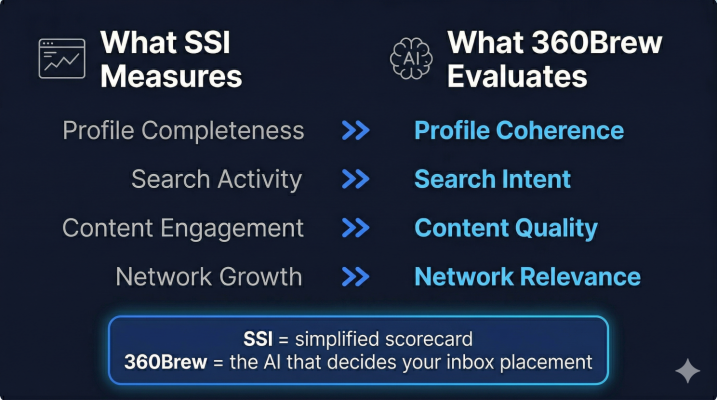 SSI vs 360Brew Comparison
Here's where it gets interesting.
LinkedIn has been openly shifting away from SSI as a primary metric. Their official line? "A high SSI score doesn't always represent the efficacy of a salesperson or correlate with measurable sales outcomes."
Fair enough. But here's what they're not saying: 360Brew - LinkedIn's 150-billion-parameter AI model - is evaluating every single behaviour that SSI measures. It's just doing it at a deeper level.
360Brew doesn't look at your SSI number. It looks at what your SSI number reflects:
- Profile Coherence - Is your headline, About section, and content telling a consistent story? (Pillar 1)
- Search Intent - Are your search patterns focused and intentional, or scattered? (Pillar 2)
- Content Quality - Are your posts and comments generating genuine engagement or getting flagged as low-effort? (Pillar 3)
- Network Relevance - Are you connected to people in your industry, or is your network random? (Pillar 4)
Your SSI is the simplified scorecard. 360Brew is the advanced version that's actually deciding whether your connection requests land in someone's Primary inbox or get buried in "Other."
When you send a connection request or InMail, 360Brew evaluates your entire profile activity history. High SSI behaviours = high trust signals = higher visibility.
LinkedIn's own data shows personalised InMails from strong profiles see acceptance rates up to 40% higher, and sellers with multiple connections at target accounts are 16% more likely to close. Not because LinkedIn rewards the SSI number - but because the behaviours behind it are exactly what 360Brew is optimised to amplify.
The data backs this up across the industry. According to LinkedIn's own social selling research, 78% of salespeople engaged in social selling outsell their peers who don't use social media at all. And LinkedIn messages achieve a 10.3% response rate versus just 5.1% for traditional cold email (Expandi, Martal Group). The common thread? The sellers getting those results aren't just sending messages - they're doing the work that keeps their SSI behaviours strong.
Atomic Action Steps
- Stop thinking about SSI as a score to optimise. Start thinking about it as a diagnostic for the behaviours 360Brew is evaluating.
- Run a "360Brew audit" on your profile: does your headline, content, and network tell a coherent story about who you help and how? If the answer isn't obvious in 5 seconds, 360Brew is scoring you down.
- Check whether your connection requests are landing in Primary or Other inbox. If mostly Other - your SSI behaviours need attention.
4. THE SSI-TO-PIPELINE CONNECTION - NUMBERS THAT ACTUALLY MATTER
 Data Driven Stats
Let's talk real numbers.
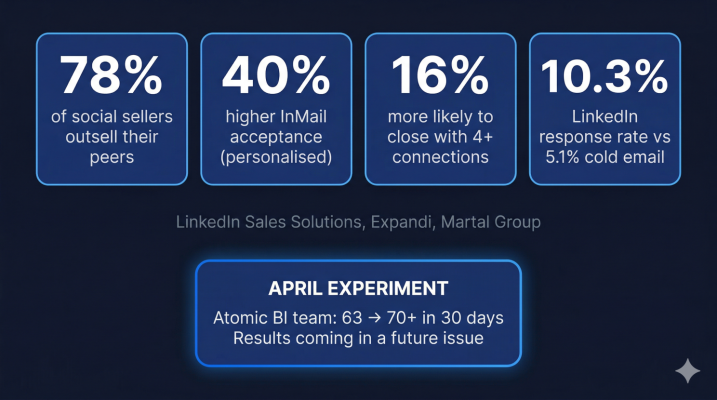
According to LinkedIn's social selling research, 78% of salespeople engaged in social selling outsell their peers who don't use social media. And LinkedIn messages achieve a 10.3% response rate versus just 5.1% for cold email.
Every connection request you send, every InMail, every comment - they all drive people back to your profile. If your SSI behaviours are weak, fewer people engage. Fewer people read your About section, see your case studies, click your CTA.
Your SSI isn't separate from your pipeline. It's the foundation.
LinkedIn also reports that sellers with 4+ connections at a target account are 16% more likely to close the deal, that average sales cycles now require engaging 11 people per target company, and that personalised InMails see acceptance rates up to 40% higher than generic ones (LinkedIn Sales Solutions). These aren't SSI stats directly - but they're stats about the exact behaviours SSI measures.
At Atomic BI, we eat our own dog food. We use our own product for outbound every day. And I'll be honest: my SSI is sitting at 62 right now. That's decent - but it's not where it should be for someone running outbound sales daily.
I know the theory. I've written three articles about the behaviours that feed this score. But knowing and doing are different things.
So we're putting ourselves on the line.
In April, we're running an internal experiment. The entire Atomic BI team - including Toby, who scored that 54 - is going to apply every recommendation in this article for 30 days. My personal goal: get from 62 into the 70s by end of month. We'll track SSI changes, connection acceptance rates, response rates, and pipeline impact weekly. And we'll report back with the results in a future Atomic Insights issue.
Because that's how we do things here. Show, don't tell.
Atomic Action Steps
- Track your SSI weekly for the next month. Screenshot every Monday morning and note the trend.
- Cross-reference your SSI trend with your outbound metrics - connection acceptance rate, response rate, meetings booked. Look for the pattern.
- Set a 30-day SSI target: if you're below 50, aim for 60. If you're 50-65, aim for 70. If you're 65-75, push for 80.
5. THE 15-MINUTE DAILY SSI ROUTINE FOR SALES TEAMS
 The 15 Minute Daily Routine to Boost your SSI
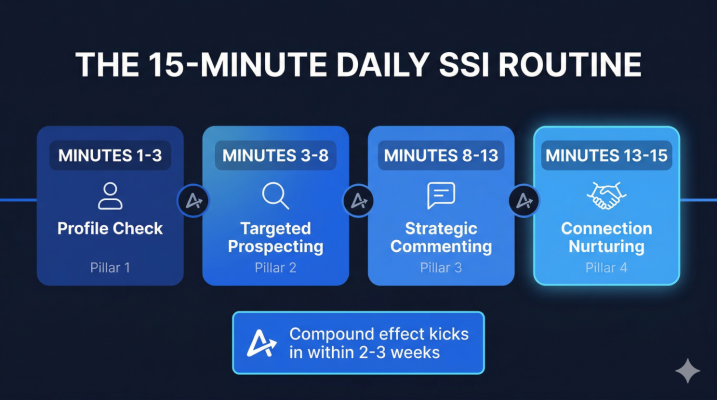
Here's the practical part. Most SSI guides tell you to "post more" and "engage with content." That's not helpful. Here's a specific daily routine you can follow in 15 minutes - and it maps directly to the four pillars.
Minutes 1-3: Profile Check (Pillar 1)
Not every day - but once a week, spend 3 minutes reviewing your Featured section and headline. Swap in your latest case study or testimonial. Update your headline if your offering has changed. Small updates signal to 360Brew that your profile is active and current.
Minutes 3-8: Targeted Prospecting (Pillar 2)
Open Sales Navigator. Run your saved search. View 10-15 profiles of people in your ICP. Not random browsing - intentional, filtered searches for decision-makers. LinkedIn tracks this, and it's one of the fastest ways to boost Pillar 2.
Pro tip: Create 2-3 saved searches in Sales Navigator - one per persona you target. Rotate between them daily. This shows 360Brew focused, consistent prospecting patterns.
Minutes 8-13: Strategic Commenting (Pillar 3)
Find 3-5 posts from prospects, clients, or industry voices. Leave substantive comments - minimum 15 words, using the formula from Atomic Insights #2: [Specific Agreement] + [New Angle/Data] + [Open Question]. This single habit is the fastest Pillar 3 booster.
Minutes 13-15: Connection Nurturing (Pillar 4)
Send 3-5 hyper-personalised connection requests. Not templates. Reference something specific from their profile or recent activity - a post they wrote, a job change, a shared connection. Quality over quantity. Always.
Remember: high-volume connection requests without personalisation will damage your SSI faster than inactivity. LinkedIn tracks your acceptance rate, and a low rate tanks Pillar 4.
That's 15 minutes. Every day. Consistently.
The SSI updates daily based on a rolling 90-day window. So the compound effect kicks in fast - most people see meaningful movement within 2-3 weeks of consistent daily effort.
Atomic Action Steps
- Block 15 minutes on your calendar every morning for this routine. Non-negotiable. Before email, before Slack, before anything else.
- Create a simple tracker (spreadsheet or notebook) with four columns - one per pillar - and note what you did each day.
- After 2 weeks, check your SSI again. Compare to your baseline screenshot from Step 1. Focus on which pillar moved most and which needs more attention.
FREQUENTLY ASKED QUESTIONS
What is a good LinkedIn SSI score for B2B sales professionals?
A good SSI score for B2B sales professionals is 65 or above. The average sales professional scores between 55 and 70. High-performing teams typically maintain averages of 65+, and the top 1% of LinkedIn users score 75 and above. According to LinkedIn's social selling research, professionals with high SSI create 45% more opportunities and are 51% more likely to hit quota than peers with lower scores.
Does LinkedIn SSI score directly affect my post reach and connection requests?
SSI does not function as a direct algorithm input that boosts visibility. However, the behaviours SSI measures - profile completeness, targeted prospecting, content engagement, and relationship building - are exactly what LinkedIn's 360Brew AI model evaluates when deciding post visibility, inbox placement, and search ranking. Improving the behaviours that raise your SSI simultaneously improves your 360Brew signals. LinkedIn also reports that personalised InMails see acceptance rates up to 40% higher - a direct result of the behaviours SSI tracks.
How often does LinkedIn update my SSI score, and what time period does it cover?
LinkedIn updates your SSI score daily, based on a rolling 90-day window of activity. This means periods of inactivity quickly degrade your score, while consistent daily effort - even just 15 minutes - can produce measurable improvements within 2-3 weeks. You can check your score at linkedin.com/sales/ssi (requires LinkedIn Premium or Sales Navigator access).
Is LinkedIn phasing out SSI? Should I still care about it in 2026?
LinkedIn has publicly stated it's shifting focus from SSI toward AI-powered tools in Sales Navigator. However, the four behaviours SSI measures - brand, prospecting, engagement, and relationships - remain the core inputs that LinkedIn's 360Brew algorithm evaluates. The dashboard may become less prominent, but the underlying behaviours it scores will remain critical to outbound sales success on LinkedIn for the foreseeable future.
How does SSI connect to outbound sales response rates?
LinkedIn's social selling research shows professionals with high SSI scores create 45% more opportunities and are 51% more likely to hit quota. The connection to outbound is indirect but powerful: SSI measures the behaviours - profile quality, targeted prospecting, engagement, and relationship building - that determine whether your outreach gets noticed. Sellers with 4+ connections at a target account are 16% more likely to close, and personalised InMails see up to 40% higher acceptance rates. A stronger SSI means stronger signals across all of those behaviours.
COMPLETE THIS WEEK:
- Check your SSI score at linkedin.com/sales/ssi and screenshot all four pillar scores (need Sales Navigator? DM me for a free 2-month referral invite)
- Identify your weakest pillar and map it to the relevant Atomic Insights issue (#1 Connections, #2 Comments, #3 Profile)
- Set a 30-day SSI target based on your current score
- Block 15 minutes daily on your calendar for the SSI routine
- Run a 360Brew coherence audit: does your headline, content, and network tell a consistent story?
- Create 2-3 saved searches in Sales Navigator, one per target persona
- Send 3-5 hyper-personalised connection requests (not templates)
- Leave 3-5 substantive comments (15+ words) on prospect or industry content
- Track your SSI weekly - screenshot every Monday and note the trend
- Compare your SSI trend to your outbound metrics after 2 weeks
Now go check that score. Mine's 62. I'm not hiding from it - I'm fixing it. And if yours is lower than you expected - good. That means you just found the leak in your pipeline.
Want to see how AI-powered LinkedIn outreach actually works - with 13-27% response rates and messaging that sounds like you, not a bot? Book a call and we'll show you.
 Let's Talk