Atomic Insights #6: Hyper-Personalised Messaging in 2026 - The Three Kinds of DMs (and Why Only One Still Works)
Last Tuesday I opened my LinkedIn inbox and counted three new DMs.
The first one started with "Hi Daniel, I hope this finds you well." I deleted it.
The second one said "Hi Daniel, congrats on building Atomic BI - I'd love to connect about AI." I left it on read.
The third one referenced my SSI article from two weeks ago, asked a specific question about how I scored on the four pillars, and ended with "no pitch, just curious." I replied in 90 seconds.
Three messages. One inbox. One reply.
That's the gap between templates, personalised, and hyper-personalised outreach. And the gap is widening every quarter.
This is Issue #6 of Atomic Insights. So far we've covered:
- Issue #1 — LinkedIn Connections: why spray-and-pray is dead
- Issue #2 — LinkedIn Comments: how your replies are doing more than you think
- Issue #3 — LinkedIn Profile Optimisation: how 360Brew is judging your profile
- Issue #4 — LinkedIn SSI: the score that predicts your pipeline
- Issue #5 — Sales Navigator Filters: why most reps build half a list
Each one was a piece of the same puzzle - how 360Brew, LinkedIn's 150-billion-parameter AI model, decides whose outreach gets seen.
This issue is about the message itself.
The 2026 reality: 57% of decision-makers say sales outreach feels impersonal and irrelevant. But 81% will engage when it's actually tailored to their company.
The bar moved. Most teams haven't.
1. THREE KINDS OF DMs - AND WHY THE NUMBERS DON'T LIE
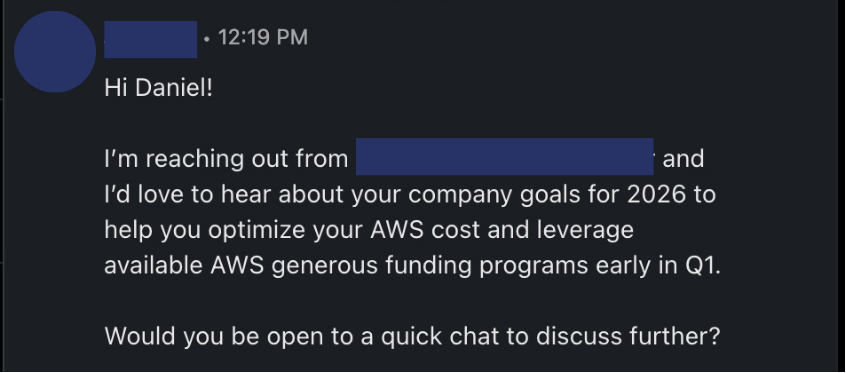 No thank you.
Most "personalisation" in B2B outreach is one of three things. They look similar. They perform completely differently.
1️⃣ Templates: A generic message blasted to thousands. The only thing that changes is the first name. These get 1-3% response rates in 2026, and most of those replies are "unsubscribe."
You already know what these read like:
- "I hope this message finds you well."
- "I stumbled upon your profile..."
- "In today's fast-paced world..."
- "As a [role]..."
- "I'm reaching out to you today because..."
If your last sent DM started with one of those, you sent a template. So did the 50 other reps your prospect heard from this week.
2️⃣ Personalised (top-and-tail). A template with a custom opening line and sometimes a custom closer. The middle is identical for everyone. These get 3+% response rates if the data is clean.
3️⃣ Hyper-personalised. Every paragraph is built from something specific to that person - their post, their company news, a hire they just made, a problem their industry is wrestling with right now. These get 13-27% response rates based on our client data, with our top campaigns hitting 27.7%.
A signal-driven personalised message gets 18% reply rates. That's 5.2x the average for generic outreach.
The 5x gap isn't a marketing claim. It's the difference between a message a human wrote about a real person and a message a junior rep pasted from a Google Doc.
360Brew already knows the difference. Every paragraph it scores looks at length, lexical variety, and whether the content references anything specific to the recipient. The flatter your DMs read, the lower your sender quality score, the further your future messages get buried.
This connects directly to what we covered in Atomic Insights #4 (LinkedIn SSI). Your SSI doesn't drop because your messages got worse. It drops because the system noticed first.
Atomic Action Steps:
- Open your last 10 sent DMs. Count how many paragraphs were identical across messages. If three or more match, you're sending templates.
- Check the response rate on your last 100 sent messages. If it's below 5%, you're in the template tier.
- Pick your single best-performing message from the last 90 days. Use it as the proof that hyper-personalisation actually works on your list.
2. THE TOP-AND-TAIL TRAP
 Don't be that guy.
Top-and-tail is the most common form of "personalisation" in B2B sales today.
The opening references something real. The closing feels human. Everything in between is the same paragraph that went to 200 other people that week.
It feels safe because it scales. It dies because prospects can smell it.
Including a personalised note in a connection request barely moves the acceptance rate. It only moves the reply rate after acceptance - from 5.44% without a note to 9.36% with one.
Read that again. The acceptance rate doesn't care about your opener. The reply rate does.
Which means the work that matters isn't the first line. It's the next four.
The reason top-and-tail still gets used is honest: it works better than templates. 5-10% beats 1-5% and it's efficient. However, most reps don't realise there's another tier above it.
And here's where the maths bites.
A 7% top-and-tail reply rate on 100 messages is 7 conversations.
A 20% hyper-personalised reply rate on the same 100 messages is 20 conversations.
Three times the pipeline from the same list, in the same week.
We see this in client data too. The accounts that move from top-and-tail to hyper-personalised don't double their reply rate. They triple it.
Atomic Action Steps:
- Print your most-used DM template. Cross out everything that isn't the first or last sentence. What's left? That's the part you're actually sending.
- Rewrite the middle paragraph for one specific prospect. Reference their post, their hire, their funding round, or their specific industry problem.
- Send that version once. Compare the response to your last five top-and-tail sends. The signal will be obvious.
3. HYPER-PERSONALISED IS A SYSTEM, NOT A SENTENCE
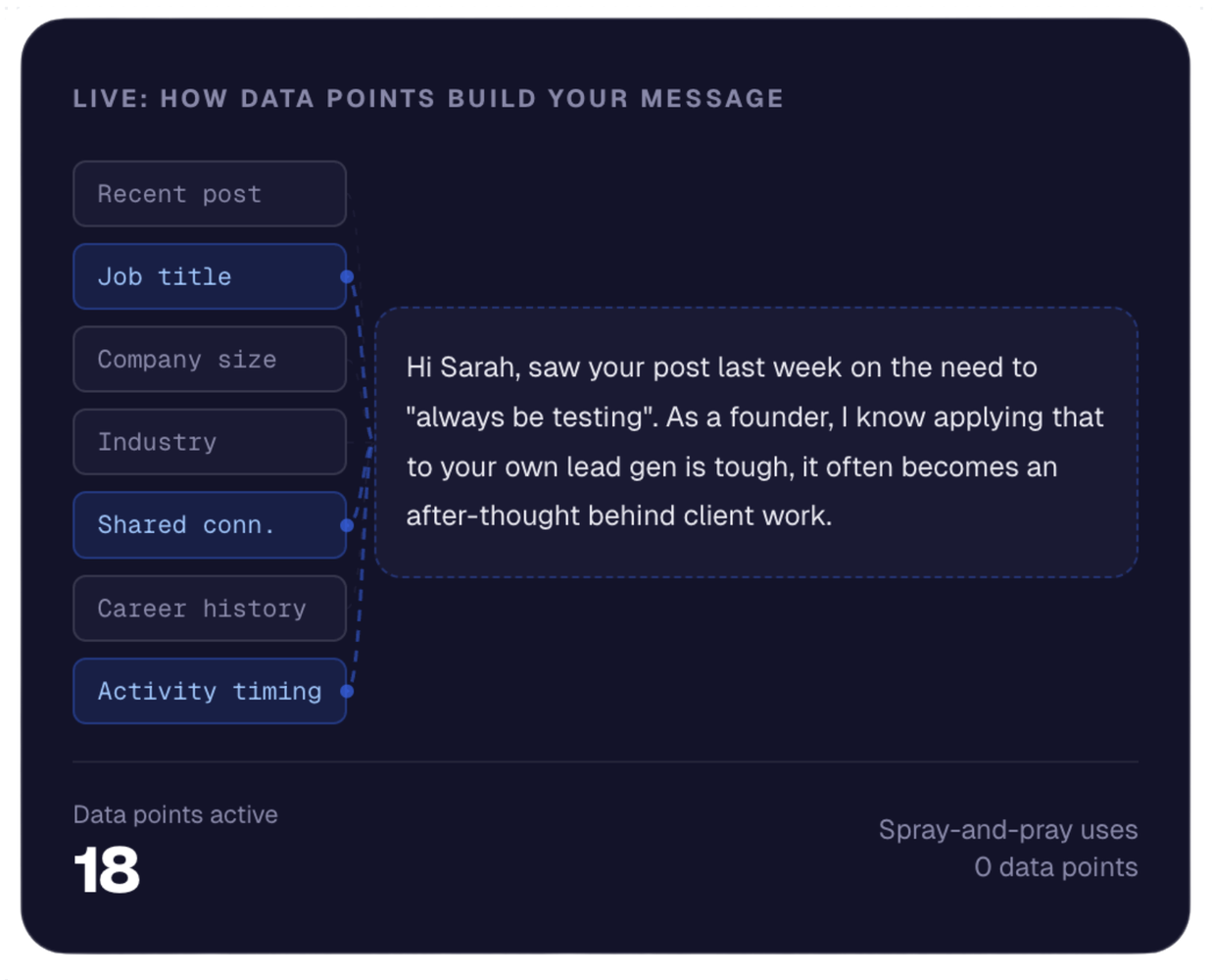 A peek behind the Atomic BI engine
The structure we use across every Atomic BI campaign has five steps stacked together:
- Icebreaker - a specific, contextual, human observation. Not flattery. Not "great post."
- Point of inflection - the pain you've identified in their world right now.
- Why it matters - the business impact of that pain (revenue, time, team).
- How it fits their world - how your work complements what they're already doing. Not a pitch.
- Curiosity CTA - low friction, ends with a question they'd actually answer.
Five steps. One message. The data driven approach we run on today:
- ≤175 words.
- ≤500 characters.
- 3-6 short paragraphs.
- Always under 400 characters when it can be - InMails under 400 get 22% higher response rates than longer ones.
People see our messages and think 175 words is too long. But again and again our data shows that prospects will respond to longer messages - as long as it's engaging.
Most outreach fails because it picks one of those five steps and skips the other four. A specific icebreaker with no point of inflection is flattery. A "why it matters" line with no icebreaker is a brochure. A curiosity CTA on a generic message is just a quieter pitch.
The reason this is a system, not a sentence, is that you can't write one paragraph and call it hyper-personalised. The whole message has to come from somewhere real - on both sides.
That's the part most teams miss. The icebreaker can't just reference the prospect. It has to connect that signal to something authentic about the sender too. A hobby. A shared experience. A passion. A specific career fact only this sender would have.
"Appreciated your post on long-term project planning - it reminded me of the pacing required for a marathon."
That sentence works because both halves are real. Take either half away and it collapses into top-and-tail.
This is also where 360Brew earns its keep. The model doesn't just check if your hook references the recipient. It looks at how the rest of the message follows that hook. If the opening references their post and the next paragraph could have gone to anyone, the system notices the seam.
We covered this drift in Atomic Insights #1 (Connections) - 360Brew is reading your sent folder, not just your profile.
Atomic Action Steps:
- Take your next outreach message. Score it 1-5 against each of the five steps - icebreaker, point of inflection, why it matters, how it fits their world, curiosity CTA.
- Any score below 3 is the weakest link. Rewrite that step first.
- Cap the final message at ≤175 words and ≤500 characters across 3-6 short paragraphs. If it doesn't fit, the message has two ideas - cut one.
4. WARM UP BEFORE YOU REACH OUT
 A small effort goes a long way
The single highest-leverage move in 2026 outreach happens before you ever send a message.
It's the warm-up. And the data on it is unreal.
Cold connection requests rarely clear 30% acceptance. Connection requests after engaging with a prospect's content push above 60%, and, first-message reply rates close to double with prior engagement.
Same prospect. Same message. Different sequence. Almost double the result.
The warm-up isn't complicated. It's three to five days of light touches before the request goes out:
- Like a recent post they wrote
- Leave one specific comment that adds something (not "great post")
- View their profile so they see the visit
- Follow their company
Each touch is a small signal to 360Brew that you're not a stranger arriving with a pitch. By the time the connection request lands, the recipient has seen your name three times. The brain treats it as familiar.
We wrote about this in detail in Atomic Insights #2 (Comments). The comments aren't just for visibility. They're for building the recognition that makes the eventual DM convert.
The mistake most teams make: skipping the warm-up because it doesn't scale. It scales fine if you stop sending 200 cold messages and send 50 warm ones instead. The maths still works.
Atomic Action Steps:
- Pick 20 prospects this week. For each, find their three most recent posts.
- Comment (using at least 10+ words) with one specific sentence on the post that's most relevant to your work. Not simply "great insights."
- Wait 48 hours, then send the connection request with a note that references the comment thread.
5. CONNECT, ACCEPT, "SHOW ME YOU KNOW ME"
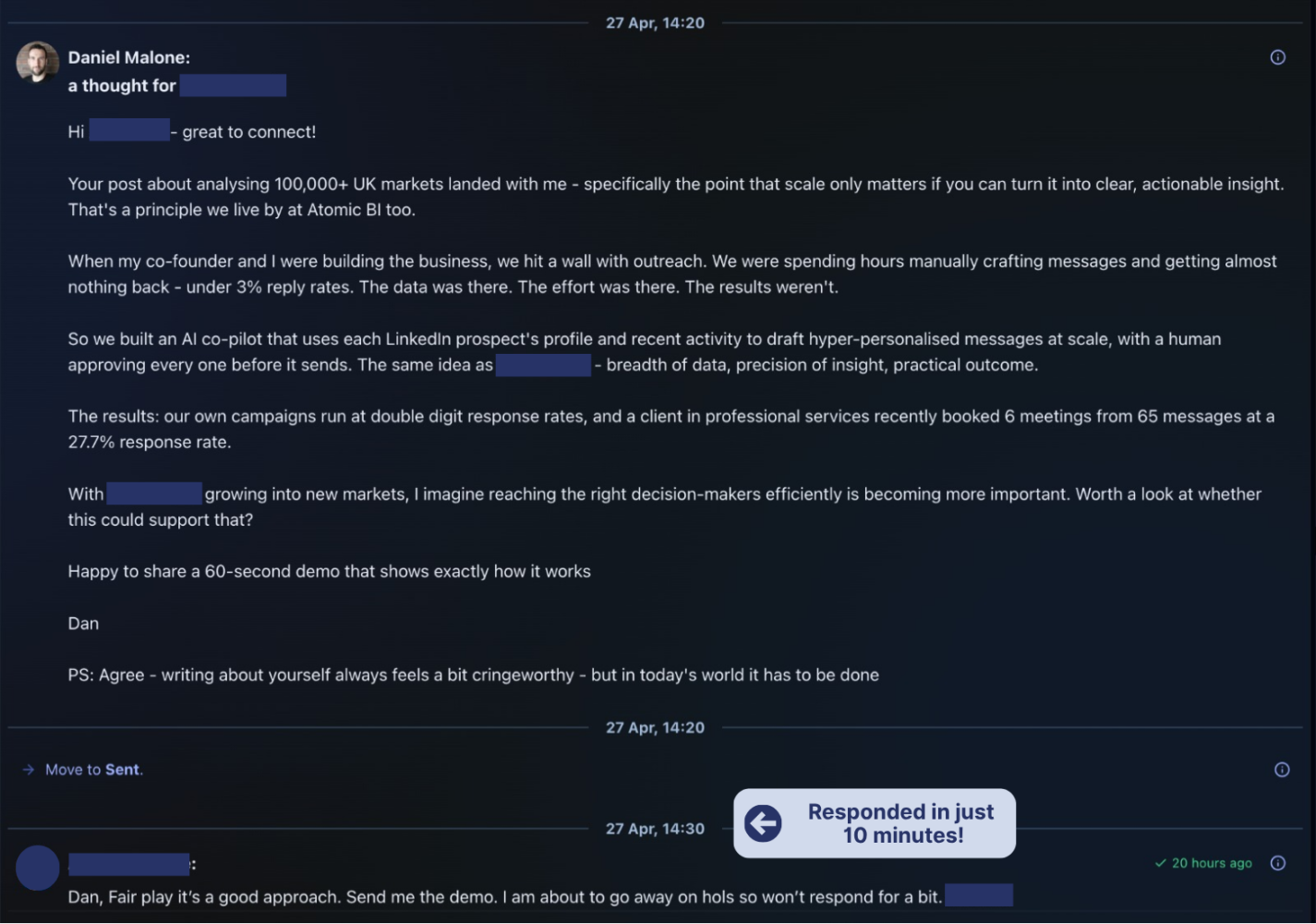 This method works - I frequently get immediate responses in minutes!
Once the connection accepts, the first DM has one job.
Show them you know them. That's the whole brief.
The instinct most reps have is to introduce themselves and explain what they do. That's a wasted message. The prospect can read your profile if they want to.
The first DM should:
- Open with one specific reference (something they posted, said, built, hired)
- Show in two lines that you understand their world right now
- End with a low-commitment question, not a CTA
Multi-channel sequences combining LinkedIn DMs with related touch points achieve 18-25% engagement rates, compared to single-channel cold outreach.
We see this work consistently across our clients.
- Manish Chawda at NIA hit a 50% response rate on his first 24 messages - 12 replies, 10 interested prospects.
- Gary Weston hit 28% response rates & 45% meeting booking rate over his first 3 months of campaigns.
- Nicholas Eng at FunnelCycle ran a 16.2% average response rate, achieving 32 meetings over 6 months.
Three different time-frames. Three different senders. Same pattern: warm-up before connection, hyper-personalised first DM, no pitch in message one.
The ones that miss the mark do the opposite. They lead with the product. They open with "Hi {firstName}." They ask for a call before earning the right to send a DM.
This is also why we build campaigns at Atomic BI the way we do. Every Playbook in our system is built on a Knowledge Base of the user's own business, then layered with prospect-specific signals - 18 data points per prospect, scored before the message goes out. The AI drafts. The human approves. The message goes when it's right, not when it's ready.
That's the loop. And it only works if every step before the DM has done its job.
Atomic Action Steps:
- Write your next first-DM in three sentences only. One reference, one observation, one question.
- Cut every word that could have gone to anyone else. If three words could be deleted without changing the meaning, delete them.
- Schedule it 24 hours after connection acceptance, not within 5 minutes. Time is part of the signal.
FREQUENTLY ASKED QUESTIONS
What is hyper-personalised LinkedIn messaging?
Hyper-personalised LinkedIn messaging is outreach where every paragraph is built from a specific signal about the recipient - their post, hire, company news, or industry problem. It is distinct from template messaging (no personalisation) and top-and-tail personalisation (custom opener and closer with a generic middle). Hyper-personalised messages typically get 13-27% response rates in B2B outreach, compared to 1-5% for templates.
What's the difference between personalised and hyper-personalised?
Personalised messaging changes the opening or closing line based on the recipient. Hyper-personalised messaging changes every paragraph based on the recipient. The difference shows in response rates: personalised top-and-tail messages average 5-10%, hyper-personalised messages average 13-27%.
Does the warm-up before sending a connection request actually work?
Yes. Warming up a prospect with 3-5 days of engagement (likes, comments, profile views) before sending a connection request raises acceptance rates from the 20-30% cold baseline to over 60%. First-message reply rates after acceptance also rise from 8% to 14% with prior engagement.
How long should a hyper-personalised LinkedIn DM be?
The optimal length for a hyper-personalised first DM is ≤175 words and ≤500 characters across 3-6 short paragraphs. LinkedIn data shows InMails under 400 characters receive 22% higher response rates than longer ones. The five steps of a strong message - icebreaker, point of inflection, why it matters, how it fits their world, and a curiosity CTA - can fit inside that limit if every word is earning its place.
What should the first DM after connection acceptance say?
The first DM after a connection accepts should reference something specific about the recipient, show one line of understanding about their world, and end with a low-commitment question - not a pitch or call request. The phrase "show me you know me" is the whole brief.
COMPLETE THIS WEEK:
- Audit your last 10 sent DMs - identify whether you're sending templates, top-and-tail, or hyper-personalised
- Pick 20 prospects and warm them up over 3-5 days before sending connection requests
- Rewrite your most-used template middle paragraph for one specific prospect this week
- Cap your next first-DM at ≤175 words, ≤500 characters, 3-6 short paragraphs
- Schedule the first DM 24 hours after connection acceptance, not immediately
- Track response rates by tier (template vs top-and-tail vs hyper-personalised) for the next 30 days
The truth about LinkedIn in 2026: there is no shortcut to a real conversation. There's only the system that earns it.

Want to see how AI-powered LinkedIn outreach actually works - with 13-27% response rates and messaging that sounds like you, not a bot? Book a call and we'll show you.